 W.A. Mozart
Piano Concerto No.5 in D, 1. Allegro
Malcolm Frager- Piano
Marc Andreae - Conductor
Orchestra of Italian Language Radio and Television of Switzerland
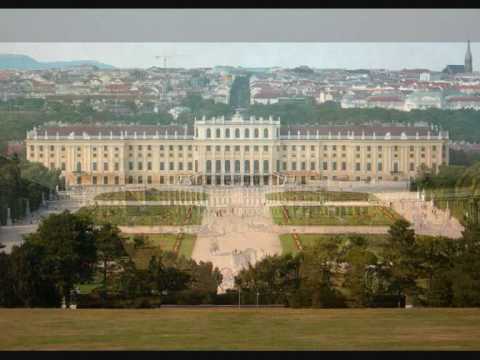
Photos : Schönbrunn Palace, Vienna, Austria
Schönbrunn Palace
Schönbrunn Palace is a former imperial summer residence in Vienna Austria. One of the most important cultural monuments in the country, since the 1960s it has been one of the major tourist attractions in Vienna. The palace and gardens illustrate the tastes, interests, and aspirations of successive Habsburg monarchs.
Early history
In the year 1569, Holy Roman Emperor Maximilian II purchased a large floodplain of the Wien river beneath a hill, situated between Meidling and Hietzing, where a former owner, in 1548, had erected a mansion called Katterburg. The emperor ordered the area to be fenced and put game there such as pheasants, ducks, deer and boar, in order to serve as the court's recreational hunting ground. In a small separate part of the area, "exotic" birds like turkeys and peafowl were kept. Fishponds were built, too.The name Schönbrunn (meaning "beautiful spring"), has its roots in an artesian well from which water was consumed by the court.During the next century, the area was used as a hunting and recreation ground. Especially Eleonore Gonzaga, who loved hunting, spent much time there and was bequeathed the area as her widow's residence after the death of her husband, Ferdinand II. From 1638 to 1643, she added a palace to the Katterburg mansion, while in 1642 came the first mention of the name "Schönbrunn" on an invoice. The origins of the Schönbrunn orangery seem to go back to Eleonore Gonzaga as well.
Modern era
Emperor Leopold I gave architect Johann Bernhard Fischer von Erlach the order to design a new palace. His first draft was a very utopian one, dealing with different antique and contemporary ideals and trying to top its role model Versailles. His second draft showed a smaller and more realistic building. Construction began in 1696 and after three years the first festivities were held in the newly built middle part of the palace.Few parts of the first palace survived that century, because especially Maria Theresa of Austria to whom the estate was made as a present by her father (who, himself, had shown but little interest in it) had decided to make it the imperial summer residence, after she was crowned. She ordered her architect-of-the-court Nicolò Pacassi to reshape the palace and garden in a way of the style of the Rococo era. At the end of the so-called Theresianian epoch, Schönbrunn Palace was a vigorous centre of Austria's empire and the imperial family, and stayed their summer residence until the more-or-less "abdication" of Charles I of Austria, in 1918.In the 19th century one name is closely connected with Schönbrunn's, Emperor Franz Josef I of Austria. He was born there, spent the majority of his life there and died there on November 21, 1916 in his sleeping room. Through the course of his 68-years reign, Schönbrunn Palace was seen as a Gesamtkunstwerk (total work of art) and remodelled in accordance with its history.
Malcolm Frager - W.A. Mozart Piano Concerto No.5 in D, 1. Allegro | |
| 19 Likes | 19 Dislikes |
| 2,899 views views | 6,195 followers |
| Music | Upload TimePublished on 14 Apr 2010 |

Không có nhận xét nào:
Đăng nhận xét