 C.W. Gluck
"Orphée et Eurydice" 1859 Berlioz Version
Retitative "Quelle epreuve crudlle!" & "J'ai perdu mon Euridice"
Anne Sofie von Otter -- Orphee
Barbara Hendrics - Eurydice
John Eliot Gardiner - Conductor
Monteverdi Chior
Orchestra of the Opera de Lyon
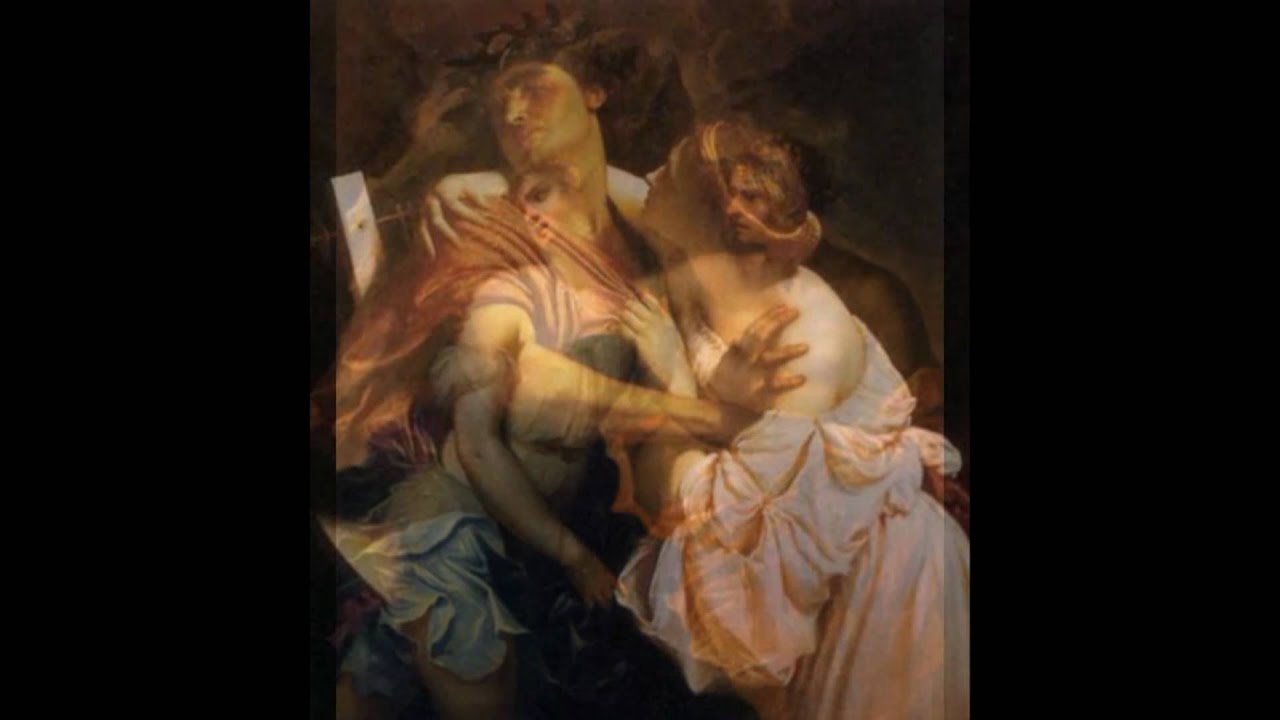
Paintings (after first title):
1.Jean-Baptiste Camille Corot (1796 -- 1875 )
2.Load Frederic Leighton (1830-1896)
3.Federico Cervelli (1625 — before 1700)
4.George Frederic Watts (1817 -- 1904)
5.George Frederic Watts (1817 -- 1904)
6.George Frederic Watts (1817 -- 1904)
7.George Frederic Watts (1817 -- 1904)
8.Christian Gottlieb Kratzenstein (1783 -- 1816)
9.Jean Raoux (1677--1734)
10.Jean-Baptiste Camille Corot (1796 -- 1875 )
~Retitative "Quelle epreuve crudlle!"~
A duet in which both sing of their unhappiness, Euridice because she feels herself spurned, Orpheus (Orphee) because he cannot explain the constraint he is under. The music slows as we reach the climax of tension: he turns back to face her ... and she dies instrantly...
~"J'ai perdu mon Euridice"~
Orphee's famous aria, he sings desparately "What shall I do
without Euridice?"
~Eurydice~
Eurydice in Greek mythology, was an oak nymph or one of the daughters of Apollo (the god of light). She was the wife of Orpheus, who loved her dearly; on their wedding day, he played joyful songs as his bride danced through the meadow. One day, a satyr saw and pursued Eurydice, who stepped on a venomous snake, dying instantly. Distraught, Orpheus played and sang so mournfully that all the nymphs and gods wept and told him to travel to the Underworld and retrieve her, which he gladly did. After his music softened the hearts of Hades and Persephone, his singing so sweet that even the Erinyes wept, he was allowed to take her back to the world of the living. In another version, Orpheus played his lyre to put Cerberus, the guardian of Hades, to sleep, after which Eurydice was allowed to return with Orpheus to the world of the living. Either way, the condition was attached that he must walk in front of her and not look back until both had reached the upper world. However, just as they reached the portals of Hades and daylight, he could not help but turn around to gaze on her face, and Eurydice vanished again from his sight, this time forever.
The story in this form belongs to the time of Virgil, who first introduces the name of Aristaeus and the tragic outcome. Other ancient writers, however, speak of Orpheus' visit to the underworld in a more negative light; according to Phaedrus in Plato's Symposium, infernal gods only "presented an apparition" of Eurydice to him. Ovid says that Eurydice's death was not caused by fleeing from Aristaeus but by dancing with naiads on her wedding day. In fact, Plato's representation of Orpheus is that of a coward; instead of choosing to die in order to be with the one he loved, he instead mocked the gods by trying to go to Hades and get her back alive. Since his love was not "true" — meaning he was not willing to die for it — he was actually punished by the gods, first by giving him only the apparition of his former wife in the underworld, and then by being killed by women.
The story of Eurydice may actually be a late addition to the Orpheus myths. In particular, the name Eurudike ("she whose justice extends widely") recalls cult-titles attached to Persephone. The myth may have been derived from another Orpheus legend in which he travels to Tartarus and charms the goddess Hecate.
The story of Eurydice has strong parallels to the Japanese myth of Izanami, as well as to the Mayan myth of Itzamna and Ix Chel, the Indian myth of Savitri and Satyavan, the Akkadian/Sumerian myth of Inanna's descent to the underworld, and the Biblical story of Lot and his wife.
Anne Sofie von Otter&B,Hendricks-Gluck"Orphée et Eurydice" Retitative & J'ai perdu mon Eurydice | |
| 35 Likes | 35 Dislikes |
| 7,590 views views | 6,195 followers |
| Music | Upload TimePublished on 5 Nov 2010 |

Không có nhận xét nào:
Đăng nhận xét